
Your washer just died. Or maybe it’s the fridge making that weird humming noise again. Either way, you’re standing in your kitchen or laundry room asking the same question thousands of Abilene homeowners ask every month: do I fix this thing, or do I just buy a new one?
It’s not always an easy call. A repair might save you money today but leave you facing another breakdown in six months. A new appliance costs more upfront but might run smoothly for the next decade. Let’s break down exactly how to make this decision with confidence.
The 50/50 Rule: A Simple Way to Decide
Most appliance repair professionals use something called the 50/50 rule. It’s a quick gut-check, not an exact science, but it works well for most situations.
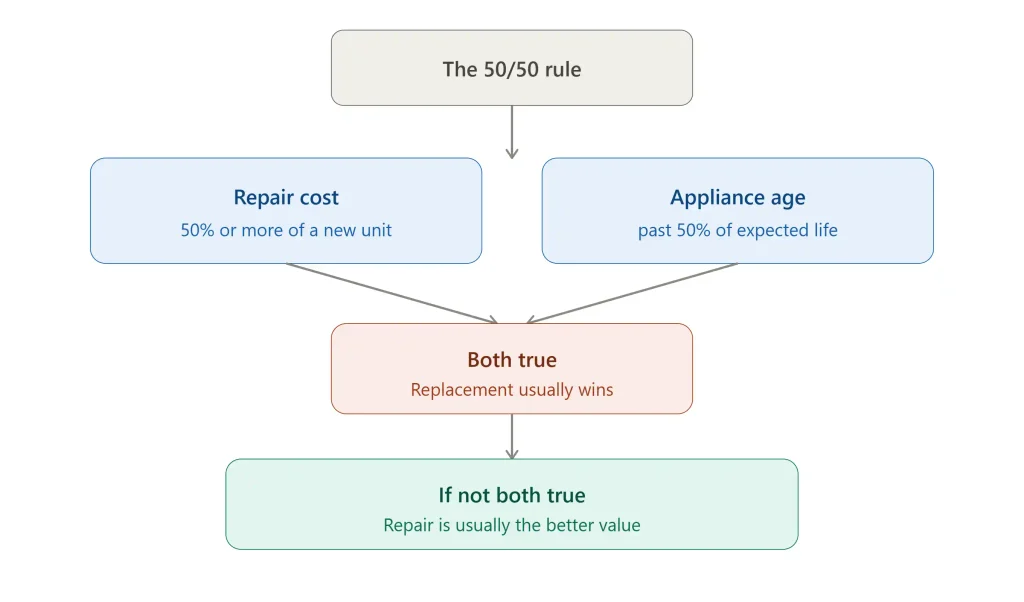
Here’s how it goes: if the repair cost is 50% or more of the price of a new appliance, and the appliance is already more than 50% through its expected lifespan, replacement usually makes more financial sense.
So if your dryer is 8 years old and dryers typically last 12-14 years, that’s over half its life gone. If fixing it would cost $300 and a new one runs $600, you’re right at that 50% line. In that case, replacing might be the smarter move, especially if the dryer has had other problems recently.
On the other hand, if your refrigerator is only 3 years old and the repair costs $200 on a $1,200 fridge, repairing is almost always the better choice.
How Long Do Appliances Actually Last?
Knowing your appliance’s expected lifespan helps you use the 50/50 rule properly. Here’s a general breakdown based on typical usage:
Keep in mind these numbers are averages. An appliance that’s well-maintained, cleaned regularly, and not overloaded will often outlast these estimates. One that’s been neglected might not make it that far.
Questions to Ask Before You Decide
The 50/50 rule is a great starting point, but a few other factors matter too.
1. How often has it broken down before?
If this is the third repair call in two years, you’re probably just delaying the inevitable. Appliances that keep failing usually have deeper issues that a single fix won’t solve.
2. Is the problem minor or major?
A broken door seal or a clogged drain hose is a simple, cheap fix. A failed compressor or a burned-out motor is a different story entirely and often costs close to what a new unit would run.
3. Do you love the appliance, or is it just okay?
If you’ve been wanting to upgrade anyway, say to a more energy-efficient washer or a fridge with more space, a breakdown might be the nudge you needed.
4. Are parts still available?
Older appliances, especially those more than 15 years old, sometimes use parts that are hard to find or discontinued. If a technician has to hunt down a rare part, repair costs and wait times both go up.
5. What’s your budget right now?
Sometimes the math says replace, but your wallet says repair. That’s a real factor too. A $150 repair that buys you another year or two isn’t a bad trade if a new appliance isn’t in the budget this month.
When Repair Almost Always Wins
Repair is usually the right call when:
These kinds of fixes are typically affordable and get your appliance running like new again.
When Replacement Almost Always Wins
Replacement tends to make more sense when:
A Real Example: Refrigerator Compressor Repair
Compressor problems are one of the trickiest calls to make, so let’s walk through a real scenario.
Say your refrigerator is 7 years old, and a technician tells you the compressor has failed. Refrigerator compressor repair can run anywhere from a few hundred dollars up toward the cost of a mid-range new fridge, depending on the brand and whether the compressor is still under warranty.
If your fridge is a higher-end model and still has 5+ good years left in it, repairing the compressor is often worth it. But if it’s an older, basic model already showing other signs of wear, that money might be better put toward a new refrigerator with a fresh warranty.
This is exactly the kind of situation where getting an honest, upfront diagnosis matters. A good technician will tell you the real cost before doing any work, so you can make this decision with clear numbers instead of guessing.
Don’t Forget Energy Efficiency
Here’s something a lot of homeowners overlook: older appliances often cost more to run every month, even when they’re working fine. A refrigerator from 2010 can use significantly more electricity than a new Energy Star model. Over several years, those extra utility costs can add up to more than the price difference between repairing and replacing.
If your appliance is getting up there in age, it’s worth factoring in these ongoing costs, not just the upfront repair or purchase price.
The Bottom Line
There’s no single right answer for every situation, but here’s a simple way to think about it: get an honest quote first. A trustworthy repair technician will walk you through what’s actually wrong, what it’ll cost to fix, and whether that repair makes sense given the appliance’s age and condition. From there, the 50/50 rule and the lifespan chart above will help you make the final call with confidence.
Whether you decide to repair or replace, the goal is the same: get your home running smoothly again without overspending or replacing something that had plenty of life left.
FAQ Section
1. Do I need to replace my refrigerator?
Not necessarily. If your refrigerator is under 10 years old and the repair is minor, such as a thermostat or seal issue, repairing it is often the better choice. Replacement becomes more sensible once the fridge is older or the repair involves a major part like the compressor.
2. Can I repair my home appliance myself?
Some minor issues, like a clogged filter or a tripped reset button, are safe to handle yourself. But repairs involving electrical components, refrigerant, or gas lines should always go to a professional, both for safety and to avoid voiding any warranty.
3. How long does an average appliance repair take?
Most common repairs, like fixing a washer’s drain hose or a fridge’s door seal, can be completed same-day, often within an hour or two. More complex issues, such as a failed compressor or control board, may take longer if the part needs to be ordered.
4. How do you decide if a repair is worth the cost vs. buying new?
Compare the repair cost to the price of a new appliance, factor in the appliance’s age against its typical lifespan, and consider whether it’s had repeated problems. If most of those signs point toward an aging, expensive-to-fix, frequently-broken appliance, replacement is usually worth it.